


Jane's Office Manager Experience at GuyKat
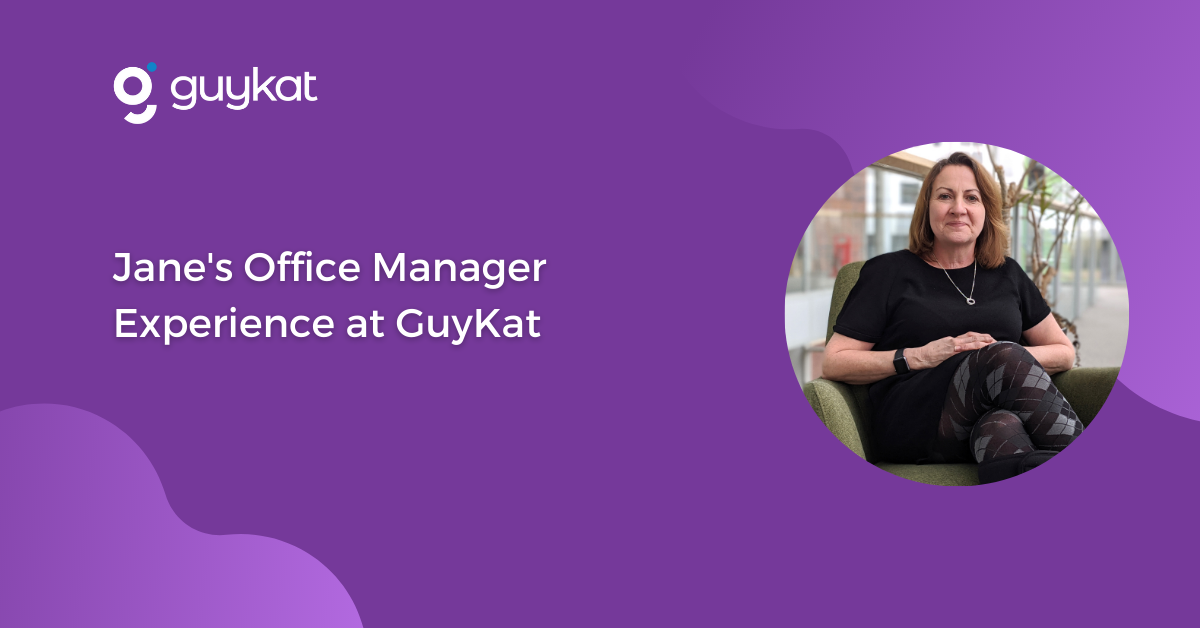
Jane joined GuyKat in 2020 as Office Manager. Today she shares what her experience with GuyKat has been like so far.
What is your role at GuyKat and how long have you been working here?
My role at GuyKat is Office Manager and I have been working here for 2 years now.
What does being an Office Manager entail?
My role is very varied. As Office Manager, I look after the day-to-day running of the office, liaise with our landlords, and make sure we have enough supplies. I also take care of a lot of the accounts for both the UK and US offices. This involves invoicing, accruals, any intercompany recharges that take place monthly, maintaining the asset register, and processing bills. I also take care of the HR side of the business, which involves arranging interviews, liaising with candidates, and helping with onboarding. As well as that, I liaise with our clients’ accounts departments regularly when chasing late payments of invoices and I am the person responsible for completing vendor assessments when we take on a new client. I also deal with our company insurance renewals, and I am the Health & Safety Officer!
How did you begin your journey as Office Manager?
I was looking for a part-time role and I really liked the advert that was posted on Indeed for the Office Manager role. The fact that the advert spoke about finding the right person and then building the role around that person according to their talents attracted me. I was also looking for flexible working and GuyKat was open to that. However, at the time of the interview, I was unable to go into the office to meet our CEO, as I had broken my ankle and wrist. The interview was conducted over Zoom and the rest is history! Guy, the CEO of GuyKat, told me to take a leap of faith and I am so glad that I did!
What do you like the most about your job?
I like the variety of tasks that fall under my remit. I really like interacting with my fellow GuyKatters, which usually starts with me calling them to arrange an interview, right through to them starting at GuyKat and then watching them grow into their role and become part of the GuyKat family.
Did you have any concerns about joining GuyKat?
Not really, only the normal first-day nerves, but I was more excited about meeting Guy and the rest of the team in person.
How have you grown since being at GuyKat?
I have always been quite confident, but I think I have grown as a person since joining GuyKat. The support that we all give each other makes it such a positive place to work - something that is quite unique in my experience.
What makes GuyKat unique?
I do believe that the people are what makes GuyKat unique. Our CEO, Guy, has a ‘2 pints and puppy’ philosophy when interviewing which means he chooses people that he believes would happily socialise and have fun with the team but also has to be trusted to look after our most precious pets, and so far he has got that spot on. I hope it can continue as we grow.
What has your experience been with GuyKat company culture?
The culture at GuyKat is a very nurturing and supportive one. We are all very different characters, carefully chosen by our CEO and yet we all gel together and help one another and support one another. I have never experienced anything like it. The backbone of Guykat is our culture and long may it continue to be so.
Any advice on those interested in pursuing a career at GuyKat?
Go for it! Really don’t hesitate to approach us. We are always looking for the right people to join our ever-expanding team. You won’t regret it!


Georgina's Translations Project Management Experience at GuyKat
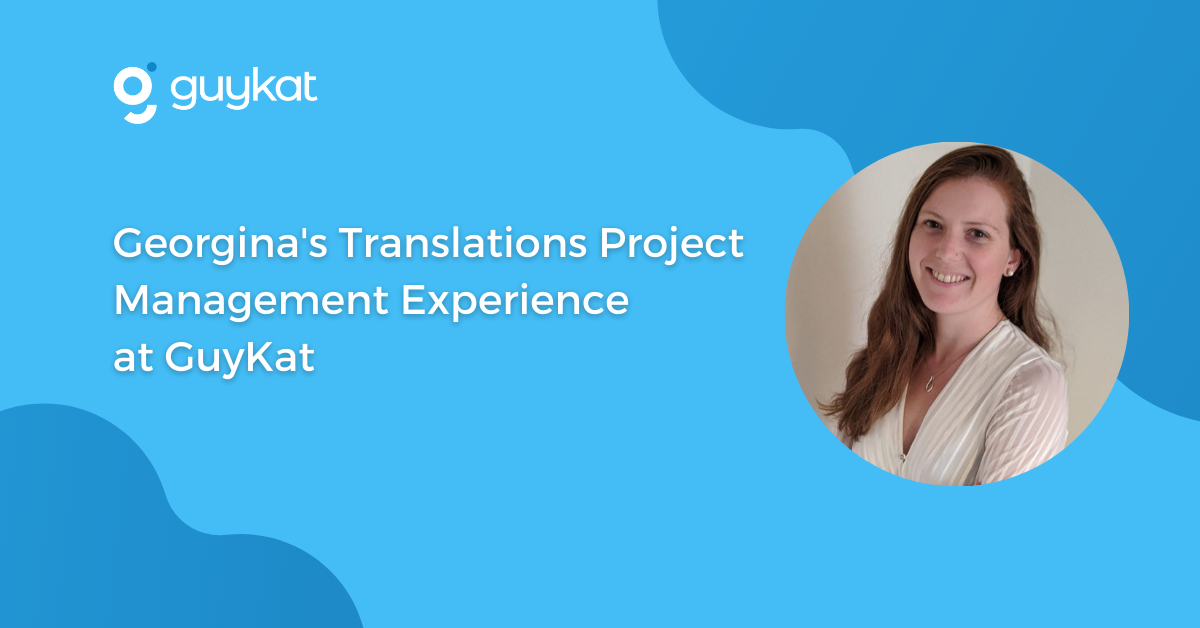 Georgina joined GuyKat’s Graduate Scheme in 2020. She now works as Translations Project Manager. Today she’s sharing what her experience has been like at GuyKat so far.
What is your role at GuyKat and how long have you been working here?
I am a Translations Project Manager and I joined in March 2020.
What does your job as Translations Project Manager entail?
I manage each step of the localization process. This involves initiating, executing, and closing projects, from project kickoffs to creating detailed project plans and deliverables. I coordinate internally and externally with stakeholders.
How did you begin your journey as Translations Project Manager?
I started in March 2020 on the Graduate Scheme where I worked in the Pro Services Team. I learned a lot about the Learning Management System (LMS) and Docebo, and also shadowed client calls. Within a week I was helping with support tickets and speaking to some of our biggest clients. In my second rotation, I worked within the Content Team and Translations where I learned to work with Articulate 360. Although I’m not very artistic, the team was very supportive when I struggled with more creative aspects. In June 2020 an opportunity came up to move into Translations. Even though I was only halfway through my Graduate Scheme, I put myself forward for the role as I thought I was an excellent fit. It wasn't an area of the business I'd thought about going into but I love languages and I love the client-side of work so it's been a really good fit.
What were you doing before joining GuyKat?
After graduating from university I went into teaching for about 8 years so I've always been in education, really. Between teaching and GuyKat I worked as a private tutor, a social media manager, a car salesman, and I went travelling. It's never too late to try something new or change your career, I think if you see something that interests you, you should go for it.
What made you initially apply to the Graduate Scheme?
I was aware of eLearning because I have spent a lot of my spare time learning new things on the computer but it had never occurred to me that I could work in eLearning. I just always sort of thought it grew on trees. The Grad Scheme at GuyKat appealed to me because it is only a year - which meant I knew I'd be busy as there's so much that goes on, covering it in a year will be fast-paced but it also means I'd hit the ground running and get my career started quickly which benefits everyone. The other reason GuyKat caught my eye is the structure of the Grad Scheme; you rotate through every area of the business so, not only do you get an excellent all-round view of how the business works, you get an opportunity to tailor your role to the areas you enjoyed working the most and you come out with a much wider range of skills.
What do you like the most about your job?
I love the fact that my projects are always incredibly varied. I get exposure to many different languages and the implementation process is always different with each project. I'm constantly being challenged to find new ways to improve the process and there are always interesting issues that come up with implementing languages.
What’s the most exciting project you’re working on right now?
I've been working on a Localisation project for a skincare brand. It's a beautiful module all about the brand history. We created the module here at GuyKat, and I've been implementing the changes into 10 languages - including Arabic which is very challenging.
Did you have any concerns about joining GuyKat?
I was concerned about starting a Graduate Scheme so long after actually graduating, as I graduated in 2010, but I was made to feel welcome and challenged where needed. I was given plenty of responsibility early on and I feel that my strengths were taken into account from day one.
How have you grown since being at GuyKat?
My role is quite face-to-face and I have become much more confident speaking to clients and managing stakeholders. I have really enjoyed being given the opportunity to make the role my own and the freedom to improve the processes. I work closely with the Content Team and they are always willing to offer advice and pitch in to help me out whenever I need it.
What makes GuyKat unique?
GuyKat has grown hugely over the last year or so and is continuing to grow at pace. It started as a small company and it has retained that small company feel. Everyone is willing to help, even if it is outside their usual work, in fact, people jump at the opportunity to learn something new.
What has your experience been with GuyKat company culture?
There is a great sense of community here, from helping each other out inside of work to spending time together outside of work.
Any advice on those interested in pursuing a career at GuyKat?
Be willing to learn and get stuck in. Give everything a go - even if you're not sure it's your thing. You never know what you might find!


Kathryn's eLearning Design Experience at GuyKat
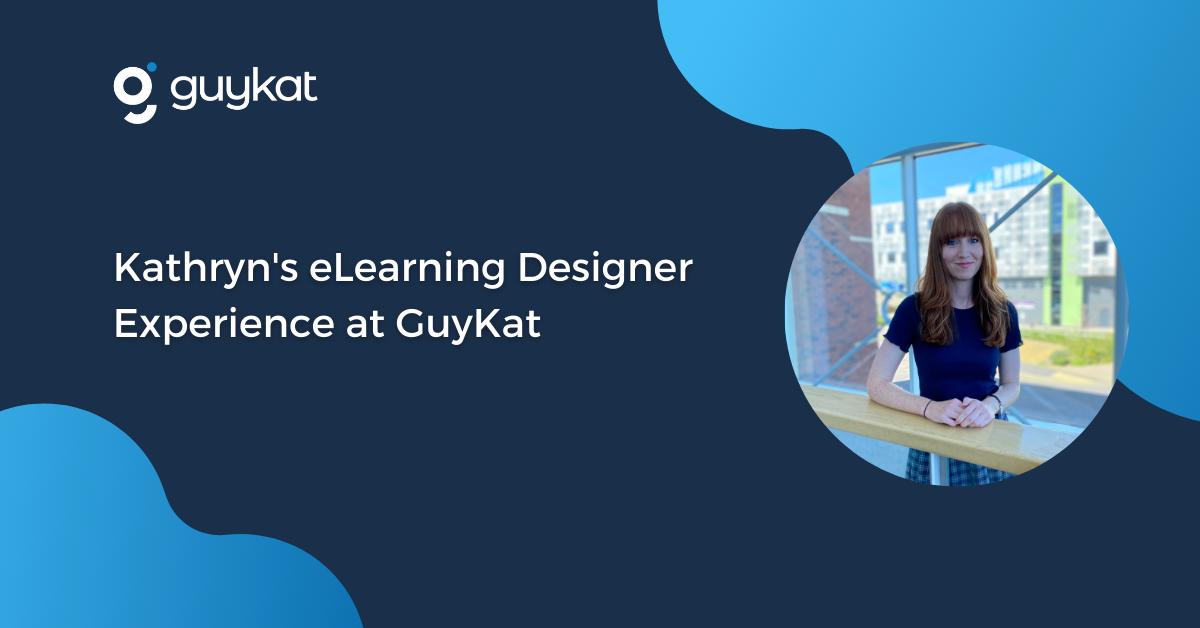
Kathryn joined GuyKat in 2020 as an Intern, before becoming one of GuyKat’s eLearning Designers three months later. Today she shares how she is finding working at GuyKat.
What does your job as eLearning Designer entail?
As part of the eLearning team, I help with the storyboarding, design, and development of eLearning modules. It’s a really great mix of logic and creativity, which I love. I’ve also had the opportunity to project manage and help out with internal processes such as onboarding, recruitment, and marketing.
How did you begin your journey as an eLearning Designer?
I started as an Intern, initially on a 3-month temporary contract. I had no experience in the eLearning industry, so it was a nice way to get a foot-in-the-door and to prove what I could do.
What were you doing before joining GuyKat?
Before joining GuyKat, I worked in recruitment for nearly four years. Although I gained a lot from the experience and I’m really glad I did it, I’ve always wanted to do something creative that would allow me to explore my passion for design and writing.
What made you decide to apply to GuyKat and change the direction of your career?
GuyKat’s culture really stood out to me. It was clear that autonomy and progression were a priority, and in the past, I’ve enjoyed having the freedom to shape my own role and career. Equally, I was excited about the prospect of designing for big brands I admire.
What was the interview process like?
It was the best interview I’ve ever had. It was a back-and-forth conversation, rather than the grilling which I’d experienced in other companies. I felt I was listened to and treated as an individual, which gave me confidence that GuyKat would mould the role around me rather than the other way round.
What do you like the most about your job?
As an eLearning designer, I enjoy the variation the most. Every project is different, which keeps things exciting because I am always learning something new. eLearning modules come in all shapes and sizes and because it’s a fairly new industry you have the opportunity to introduce new ways of working.
What’s the most exciting project you’re working on right now?
I’m currently working on a module for one of our biggest clients and it’s all about change. It’s a very interactive course and teaches the learner how to drive and respond to change in a business setting. The organisation has beautiful branding, so I’m having a lot of fun with it!
Did you have any concerns before joining GuyKat?
The only concern I had before joining GuyKat was my lack of experience in the area.
How were these concerns diminished?
Although I hadn’t worked in eLearning before, the leadership team has a knack for choosing people who they know will pick it up quickly and who are keen to learn. So if you’re eager, and you put the work in, the team will support you and you can develop very quickly.
How have you grown since joining GuyKat?
It’s crazy to look back on the last year and a half because having joined GuyKat with no direct experience, I’m now a fully-fledged eLearning Designer and I feel like a valued part of the team! Having never touched Storyline 360 or any of the Adobe software, I can now use the majority of them with confidence. I still have a lot to learn, but that keeps things interesting.
What makes GuyKat unique?
The culture makes GuyKat unique. It’s very rare to find an environment with so much freedom and with a team who are all passionate about what they do.
What has your experience been with GuyKat company culture?
We have a hugely sociable atmosphere and everybody wants to get involved. I’ve never felt so comfortable or welcomed into a company. People genuinely want to help and support each other.
What kind of support do you receive from the team?
The team is always on hand to offer training and to share their expertise. On-the-job learning is our main approach, but no question ever goes unanswered and there’s always someone willing to hop onto a call, which was especially helpful during lockdown!
Any advice on those interested in pursuing a career at GuyKat?
If you’re interested in pursuing a career at GuyKat, remember it’s all about attitude and work ethic. Although I didn’t have direct experience, I showcased what I could do in my application. It’s important to tailor your cover letter and show how much you care. The freedom you’re given isn’t for everyone, so if you’re looking for a structured, linear career path, we’re not the company for you. Being proactive, self-motivated, and taking ownership is key in my opinion, even if you have eLearning experience behind you. Also, because we’re very sociable at GuyKat, we value people who want to join in and get to know the team!


Jess's eLearning Design Experience at GuyKat
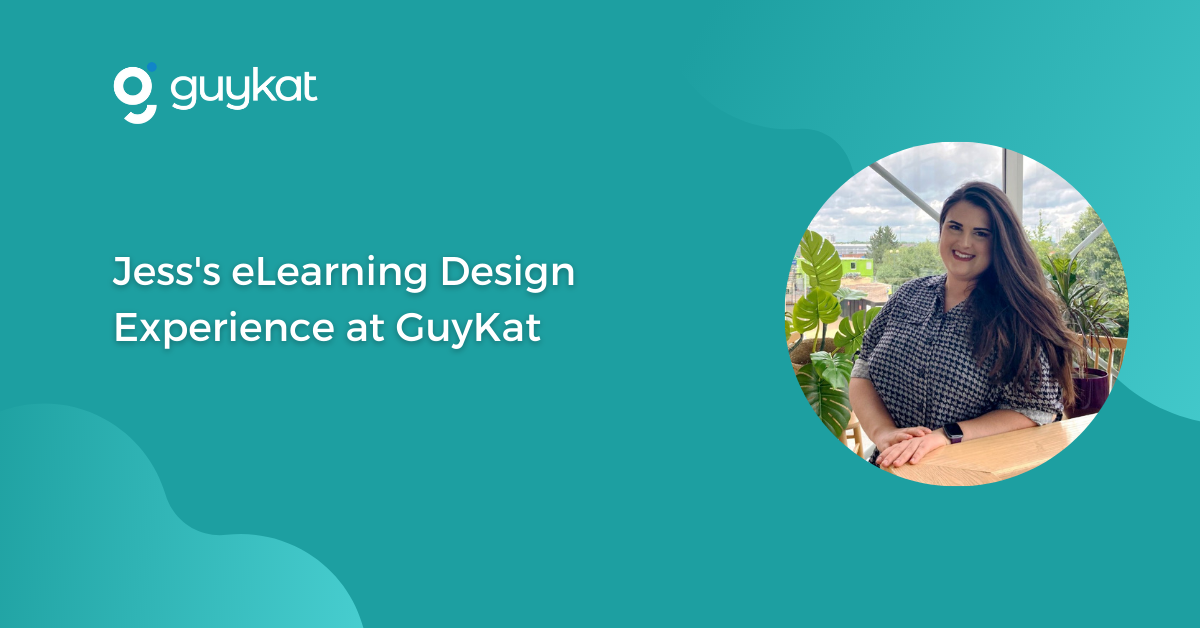 Jess joined GuyKat in 2021 as an eLearning Design Intern, before taking on a permanent role as one of our Junior eLearning Designers. Today she shares what her experience at GuyKat has been like so far.
What is your role at GuyKat and how long have you been working here?
I am a Junior eLearning Designer, and I’ve been working at GuyKat for 8 months.
What does your job as a Junior eLearning Designer entail?
My day-to-day work involves taking eLearning content provided by the client and turning it into bespoke eLearning content. The roles at GuyKat are quite flexible in that we can be involved in many different parts of that process, and personally, I enjoy getting stuck into as many different parts of that process as I can. This means on a day-to-day basis, I could be designing content on design software Articulate, storyboarding raw content, creating concept art, working on graphics and visuals for a client, or working on translated versions of modules.
How did you begin your journey as a Junior eLearning Designer?
I began as an eLearning Design Intern for 3 months before taking on a permanent role as one of GuyKat’s Junior eLearning Designers.
What were you doing before joining GuyKat?
I have been on a bit of a journey in terms of discovering what I wanted to do with my career. Before joining GuyKat I worked on an acute mental health hospital ward and as a freelance artist.
What made you decide to apply to GuyKat in the first place?
After a few years of working in mental health, I found I was missing being creative in my day-to-day work. I then enrolled for a Master's in Illustration and Animation and worked as a freelance artist before realising that I wanted to both learn and design simultaneously. When I saw the job listing for an internship at GuyKat, I knew instantly that it was the job I had been searching for. It appeared to me to be a fantastic mesh of being creative and learning at the same time, and I was not wrong!
How did you find the interview process?
Prior to the interview with GuyKat, I had had many awful interviews with other companies one after the other, so believe me when I say that the interview process with GuyKat was smooth and, dare I say, enjoyable! They were very professional but personable, and they made me feel incredibly comfortable throughout the whole process. At the end of my interview, I remember asking “What do YOU enjoy about your jobs?” and their answers convinced me that this company was one that I wanted to be a part of.
What do you like the most about your job?
I like the variety of my role. I get to work on many different subject matters in many different industries with very different branding guidelines. I can play to my strengths but am also encouraged to develop my skills and choose the kind of job that I would like to have. I can experience the various parts of the business and if, say, I’d like to get better at storyboarding, I can. If I want to learn more about UX/UI design, I can. There are so many different paths you can carve for yourself, and that’s what I like the most.
What’s the most exciting project you’re working on right now?
I’m working on a couple of exciting projects at the moment, but the most exciting project recently has been for a skincare brand. I enjoy their branding and the content has been incredibly interesting to work on and the scope of the project has allowed us to push the boundaries of what we thought we could achieve.
Did you have any concerns about joining GuyKat?
I didn’t have any concerns about joining GuyKat specifically but I was anxious to be making a huge career change. It turns out that joining GuyKat has been the best decision I have ever made for myself, and if I could go back and change one thing about my past, I would have made that decision sooner!
How have you grown since being at GuyKat?
I have grown both personally and professionally since joining GuyKat. Besides the fact that I have learned software packages and become more confident with the software knowledge I already did have, I have grown so much personally. Everyone I work with is so incredibly supportive, encouraging, and knowledgeable. It is impossible to feel small and unworthy when they make you feel so comfortable and supported in your role.
What makes GuyKat unique?
The people are what makes GuyKat unique. I have worked in many unsupportive workplaces with colleagues that just wanted to climb the career ladder, without taking anyone's feelings into consideration. It is not like that at GuyKat. My colleagues are not trying to climb the ladder by climbing on top of me, and I’m not trying to climb on top of them. If GuyKat were the Lion King, Mufasa and Scar would rule side by side and the Hyenas would not be outcasts.
What has your experience been with GuyKat company culture?
There’s a simple test about trust in the workplace where you ask yourself: “Would I have two beers with this person?” and “Would I allow this person to look after my puppy over a weekend?” I can neither confirm nor deny that many drinks have been had after work, but I can say that I would trust any of my colleagues with looking after my dog over a weekend (she’s a handful, so that’s saying a LOT).
What kind of support do you receive from the team?
My team is incredibly supportive and helpful. If I have any issues, there are many people I can ask for help, and everyone is always so full of knowledge and willing to help you with anything.
How did you find the onboarding process?
My first week at GuyKat was the best first week I have ever had. As soon as I was halfway through my first day, I knew I’d made the right decision to join GuyKat. Everything from how GuyKat came to be, how the business works, to how to use the various software we need to know was covered in that process.
Any advice on those interested in pursuing a career at GuyKat?
Apply. That’s my advice. Apply and be willing to take a lead role in your own career development. Everyone that you’ll work with wants you to succeed – you just have to work out where you want to be, and we’ll help you get there.


Helen's eLearning Design Experience at GuyKat
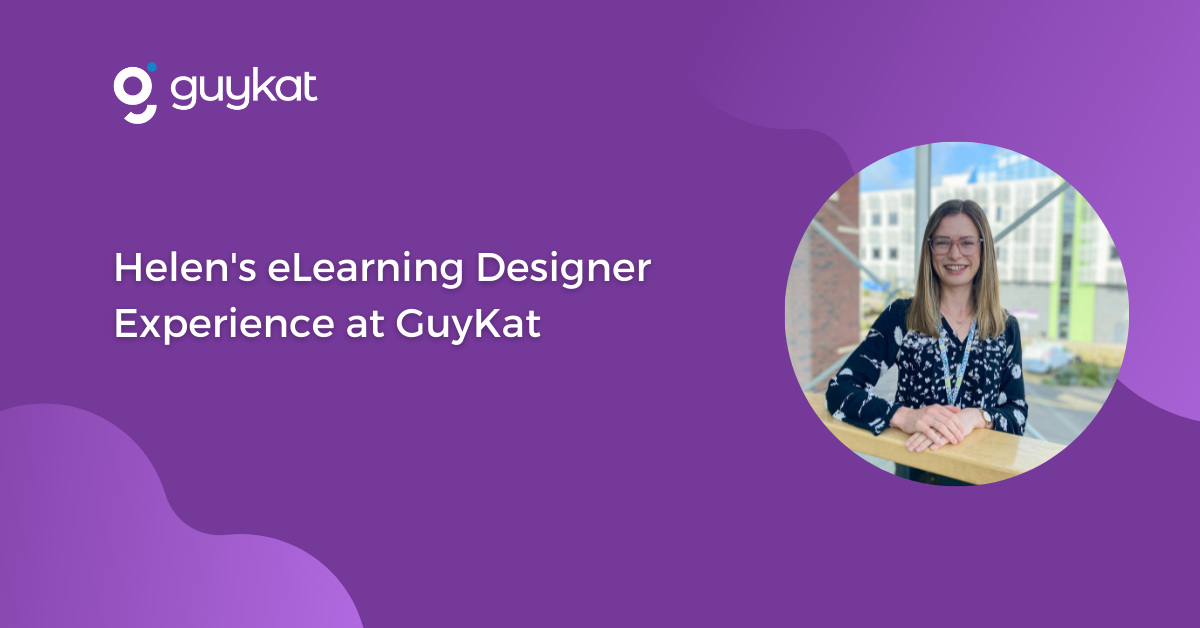 Helen joined GuyKat in 2021 as Junior eLearning Designer. Today she shares what her experience at GuyKat has been like so far.
What does your job as a Junior eLearning Designer entail?
My job is to develop eLearning modules for clients using content creation software Storyline and Rise. A usual day will consist of designing and developing the look and feel of the module, using Adobe Illustrator and Photoshop to edit image assets to input into the module, having internal team calls to check in with our progress for each project, and having client calls to keep them up to date with timelines and deal with any queries.
How did you begin your journey as an eLearning Designer?
I studied Fine Art at university which really solidified my designing process and creative thinking skills, so I knew I wanted to work in a creative industry.
What were you doing before joining GuyKat?
My first job out of university was as a Visual Merchandiser, and due to the shop closing down in the first lockdown in 2020, I took on a temporary role of Head Barista at a local farm shop. During this time, I was searching for a creative role that would allow me to explore graphic design and improve my creative skills.
What made you decide to apply for a role at GuyKat?
Having come from a background in Fine Arts, I hadn’t had much opportunity to use software such as Adobe Creative Suite professionally. However, whilst furloughed and then during redundancy, I started creating digital drawings using Procreate on my iPad and soon discovered a passion for digital art and graphic design. I realised that this was something I wanted to pursue a career in, but struggled to find jobs that allowed me to train on the job without much experience. A lot of ‘entry-level roles’ were asking for 2+ years experience in graphic design or proficiency using Adobe software. GuyKat, however, was exactly the company I was looking for: open-minded to people wanting to change the direction of their career, and able to provide the training and support to do so.
How did you find the interview process?
Interviewing at GuyKat was a really pleasant experience - it was the first time I was able to be myself in an interview process. I had the chance to ask lots of questions too about the business and came away feeling even more sure that it was the right company for me.
What do you like the most about your job?
I love that each day is different and I have the opportunity to work with amazing brands.
What’s the most exciting project you’re working on right now?
I’ve been working on a module for a skincare brand that has the most beautiful scrapbook-style branding. It has given me the opportunity to refine my skills in Illustrator and Photoshop and be more involved in client calls.
Did you have any concerns about joining GuyKat?
I was worried that my lack of experience in Adobe and eLearning authoring software would mean I wouldn’t be able to work on client projects straight away. However, I had great on-the-job training using these tools with the team and introductory training projects to practice using the software before starting on client projects. I’m quite a practical person so learning the software as I worked meant I was able to pick things up quickly, make mistakes, ask lots of questions, and I ended up starting my first client project just one month into my role at GuyKat.
How have you grown since joining GuyKat?
I’ve never learned so much so quickly! The technological side of creating eLearning modules has been a big learning curve for me (especially with things like variables and states) but with the help of my colleagues, I was able to grasp this quicker than I expected. I’ve also grown in confidence - I’m usually quite a shy person, but now feel confident to speak up in client calls, present work, make design suggestions, and do presentations at team events.
What makes GuyKat unique?
I think GuyKat is unique because eLearning is quite a niche market and so there are lots of learning opportunities as trends and technology change and evolve. There is also a lot of flexibility when you work at GuyKat - you can tailor your role to suit your skills and expertise, and have the ability to work across teams if you wish.
What has your experience with GuyKat company culture been like?
The company culture at GuyKat is fantastic and unlike anywhere I’ve been before. Everyone genuinely cares about your professional and personal development. I feel well supported and was so warmly welcomed when I first started that I was able to be myself from day one. It is great to be part of a talented and hard-working team.
What kind of support do you receive from the team?
My colleagues are always happy to hop on a call with me to help me navigate through new software or help with a query, and I’ve had the opportunity to have training sessions in design principles, Illustrator, and storyboarding. We have 1-1s every few weeks with CEO, Guy which makes me feel really well supported.
How did you find the onboarding process?
The onboarding at GuyKat was great. Within the first few weeks, I’d had training in some of the software I would be using daily, training modules to create to put what I’d learnt into practice, a couple of team days where I really grasped an understanding of what GuyKat offers as a business and what the eLearning and Professional Services teams do. All this meant that I felt like I settled into the team really quickly and learned so much every day.
Any advice on those pursuing a career at GuyKat?
If you’re applying, show us how much you enjoy learning yourself! We learn and share knowledge every day, so it’s a huge part of the role.
Do you want to join our supportive team? Click below to explore all our available vacancies.


Jay's Graduate Trainee Experience at GuyKat
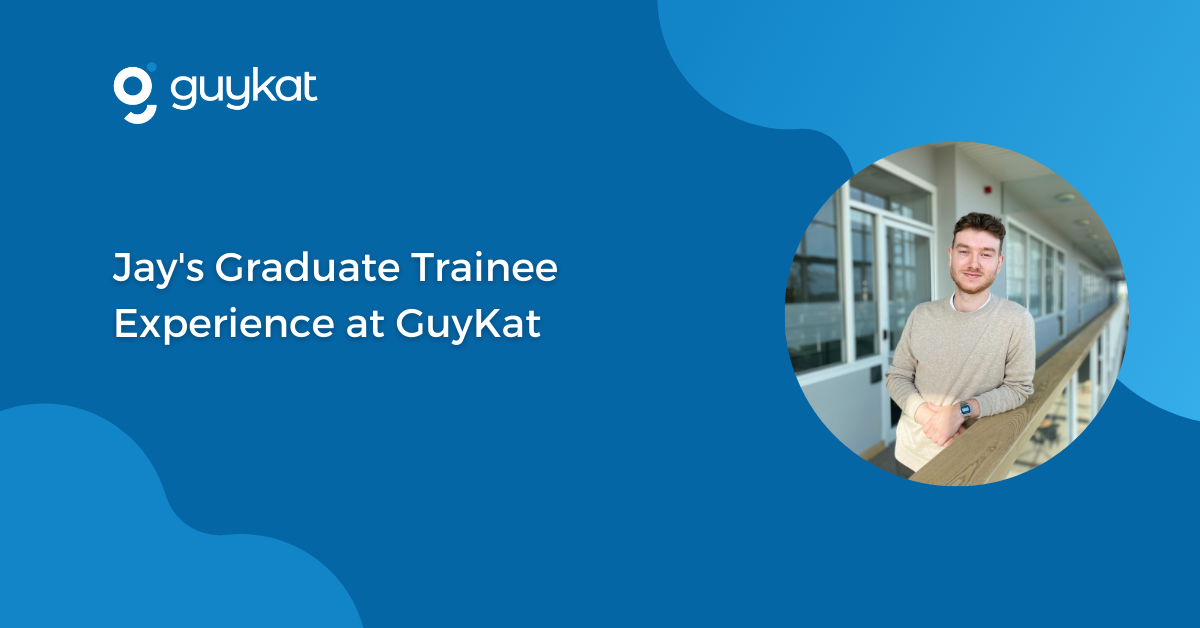 Jay joined GuyKat's Graduate Scheme in 2021. Today he shares what his experience at GuyKat has been like so far.
What does your job as Graduate Trainee entail?
My role involves completing placements and rotating around different areas of the business to gain experience from all teams, before ultimately deciding on a final role at the end. Depending on the rotation, I have the opportunity to work in all areas of the business (eLearning, Pro Services, Business Admin, Translations, and UX/UI). So far I have worked in the eLearning Team where I designed custom eLearning content for clients and learned how to use content creation software such as Storyline, Rise, Adobe Illustrator, and Photoshop. I'm currently working in the Pro Services Team and help support our clients with Docebo, a Learning Management System GuyKat is partnered with. My day-to-day is extremely varied. One day I can be helping answer clients' queries, the next I can be working on projects and helping with admin support, page design, and more. I have recently been given the opportunity to take part in client calls which has helped build my knowledge of the eLearning industry and my overall confidence when communicating professionally.
How did you begin your journey as Graduate Trainee?
I studied Sport & Exercise Science at university and after six years in the health and science industry, I no longer enjoyed going to work. I had lost the passion for what I was doing and felt ready for a change. I saw the Graduate Scheme being advertised on Indeed and applied there and then! I was really happy to have gotten through to the interview stage, which was very professional but felt relaxed at the same time. It felt like much more of a conversation rather than an interview.
What do you like the most about being a Graduate Trainee at GuyKat?
I really enjoy working with such great people and having the opportunity to work in all the different teams, as I learn a large variety of skills from each.
What's the most exciting project you're working on at the moment?
I have just finished working on a project where I worked closely with the UX/UI Team to design multiple pages for their Docebo platform. It was great to see my designs built into a functioning page.
Did you have any concerns about joining GuyKat?
I was very nervous to join GuyKat as it was a huge career change from my background in healthcare to all of a sudden being in the eLearning industry but my concerns quickly went away. The onboarding process was amazing and very quickly I felt supported. I was quickly immersed in the team and the company's culture so I felt comfortable asking for help. The team gave me the necessary resources to succeed but also gave me the independence to manage my own workload, which I appreciated. It's easy to feel a bit of imposter syndrome when you first start somewhere but the longer I've been here, the more that goes away, and that's down to the great support network at GuyKat.
How are you supported at GuyKat?
There is always so much support on offer at GuyKat. Everyone in the team receives monthly 1-1’s with Guy, the CEO of GuyKat. These give you the opportunity to talk about your professional development and where you want to go in your career. We're also encouraged to set up 'Hello Chats' with new starters which is great when you're new, as it eliminates that awkward feeling of not knowing the people you work with. As well as that, we have a Buddy System, where we have set groups that meet weekly to talk about how we're doing and have a general chat. In general, whether people are in the office or working from home that day, the people at GuyKat are always happy to offer you guidance. All you have to do is ask.
How have you grown since joining GuyKat?
I've grown a lot at GuyKat. My confidence and skills have grown a lot in such a short space of time thanks to the support of the teams I've been a part of.
What makes GuyKat unique?
GuyKat’s emphasis on learning and work ethic over past experience is what makes it unique. I was given a rare opportunity in modern-day hiring as many jobs require years of experience and high-level qualifications for entry-level jobs, whereas, at the Graduate Scheme at GuyKat, you are taught skills and trained on the job.
What has your experience been with GuyKat company culture?
From day one I felt that the company's culture and values aligned with mine. I've never felt more like a part of a team than I do right now.
Any advice on those interested in pursuing a career at GuyKat?
I would say just go for it! I nearly didn’t apply to the Graduate Scheme because of my background being different to what I thought the usual applicants would be, but I'm so glad I took the risk as I'm now gaining so much experience in an exciting industry.
Do you want to join our supportive team? Click below to explore all our available vacancies.


How to Effectively Analyse your eLearning Course Audience
 A solid understanding of who your audience is makes a big difference to an eLearning course. Without this knowledge, it is difficult for eLearning Designers to know how to tailor their approach to create the best possible user experience.
Related article: Tailoring Your Learning Content To Your Audience
In order to analyse your eLearning audience effectively, a few factors to keep in mind are:
- What the learner objective is
- What the learner hopes to gain from the training?
- How many people need it
- For what purpose the learner is consuming the eLearning
Having this information will make it easier to determine which type of content to include and which content to prioritise.
GuyKat Top Tip!
When a course is being rolled out to a larger audience, it is wise to ensure that it is easily accessible. For instance, microlearning could be used.
Your audience's previous background is another important factor to consider. What is their previous level of knowledge and learning ability? For learners who are already familiar with the content or specific jargon, you should avoid creating content that is too simplistic. Additionally, if their learning abilities are lower, make sure that the learner can comprehend the content and that it is not too challenging. Your ability to identify their needs will help you build an eLearning course they will benefit from.
Read more: Selecting The Right eLearning Format For Your Content
Knowing how the learner is going to access the eLearning course is also highly important. Consider their internet access and the type of device they will likely be using to access the course. Being mindful of limitations this may introduce will have a significant impact on the success of the eLearning. Additionally, it is important to determine if the typical target learner is proficient with the technology. If not, the design may need to be more basic.
Final Thoughts
To put it simply, when you properly understand your audience, you are more likely to deliver the most appropriate solution. Never skip the step of analysing the audience before beginning a project.
Need help with your Learning & Development? Book a call with a member of our team below.


Less Is More: Organising & Reducing Content To Make It Digestible
 Living in the digital age, with answers at our fingertips, means we are all becoming more impatient. Social media platforms consumed ‘on-the-go’, like TikTok, showing 15-second videos, are on the rise. Consequently, attention spans are decreasing. So what can we do about it?
Create content with the learner’s perspective in mind. Impatient people want you to get to the point quickly. When you look at a big chunk of text, do you fully absorb all the information? Or do you need it broken down into key points?
Why is less more?
Often, visual assets (pictures, diagrams, animations, etc.) are quicker to understand than text-heavy explanations. This helps learners draw out the key points of the content, which makes it more memorable. The author’s challenge is identifying the key takeaway points to focus on. Once this has been established, a learning plan can be generated that addresses the who, what, when, where, why, and how.
The design phase comes after the learning plan. This is where the storyboarding of ideas comes to life, and a prototype is created. After this, once the content has been decided, the course can be developed. Learners don't want to skim text to see what they need to remember. Visual assets summarise content into bitesize, easy to process chunks. Adding graphics, choosing core colours, and deciding on fonts has a huge impact on how engaging the content is. Ensuring that one sentence sums up the key points in bold, and backing up any key messages with visuals is crucial in drawing a learner’s attention.
Mark Twain's quote, "I didn't have time to write a short letter, so I wrote a long one instead," hints that it is easier to write a lot of words quickly than to be succinct. For a learning designer, the time investment required to write succinctly is always worth it.
Read more: 10 Ways To Make Your eLearning More Engaging

A checklist for selecting the right eLearning partner
 To shortlist potential eLearning partners, it's important to identify your needs and goals. Here are initial questions to ask:
- What are your expectations and goals for the eLearning content? What are you trying to achieve?
- What are your timeframes and budget?
- Do you have a preference for specific tools or technology? Will you be using your own Learning Platform?
You need to determine what parts of the process you wish to outsource. Do you already have an Instructional Designer, Developer, Project Manager and Quality Checker? How about a Translation Specialist, Narrator and Graphic Designer? Do you need a mix-and-match of the above, or do you want a full turn-key solution? Different agencies/vendors have different strengths in different areas. Be clear about which areas you need help with.
Once you have determined your needs and completed your research, you can evaluate your shortlist based on the below criteria:
Approach and Values
A partner should be much more than just a supplier. Partnerships encourage an open dialogue. Good partners understand your requirements and offer challenges and suggestions. A supplier would simply do what you ask, whereas a partner would be confident to advise that what you're asking for isn't what you really need and suggest alternatives. They will give transparent guidance on price, scope and content ideas. Consider whether you would trust them with confidential or sensitive information and ask how they've dealt with similar projects in the past. You want to work with people you feel you trust.
Quality Experience
The amount of experience an eLearning company has is important, but experience doesn't necessarily equate to quality. You can assess this via social media, blogs and client testimonials. eLearning companies sometimes post their work online, but many projects are confidential so take a look at the industries they work within. Ask yourself these questions: Are their clients reputable? Have they worked on similar projects to yours in the past? Can you request to see a demo?
eLearning content creation is an unregulated industry. Anyone can access authoring software and declare themselves an expert developer. Be wary. Make sure you do this basic due diligence to ensure the candidate agency is credible.
Project Management Processes
An eLearning company's approach toward project management and communication is integral when deciding if they're the right partner. It's worth asking: Will there be a single point of contact and are they likely to remain the same throughout? Are they able to ramp up resources if necessary? What is their quality checking processes? How many rounds of feedback are factored in? Do they prioritise after-sales care and technical support?
The best partners will be able to adapt and tailor their approach project-by-project and flex their processes to suit the individual client.
Learning Platform Capability
Once your content is developed, you'll need a system to host the eLearning (i.e. a Learning Platform). If you do not have your own, you'll need to find the right platform for you. Some of the best eLearning companies will have everything you need in one place. GuyKat is proud partners of Docebo, which means alongside our eLearning expertise we can help with implementation, outsourced administration and design, User Experience and User Interface. We also have an internal software team that can build whole new functionality from scratch. To think through the long term ambition for your content strategy, and check if your current platform is a good fit for that ambition, use our Capability Maturity Model.
Final Thoughts
A long-lasting relationship with the right eLearning partner will be the most efficient and effective way to deliver engaging content. At GuyKat, all of our partnerships go beyond providing outsourcing support. Alongside the above criteria, the right eLearning partner will truly care about your goals and learning needs.

Upskilling vs Reskilling: Understanding differences and similarities
Like most industries, L&D professionals have a habit of using industry jargon. Jargon can exclude bright people from being able to make valid contributions to a debate. At GuyKat, we want to be inclusive. We’re on a mission to bust the jargon. Last week we demystified the words 'asynchronous' and 'synchronous'. This week we're ready to do the same with ‘upskilling’ and ‘reskilling’...
What is upskilling?
In short, upskilling is learning fresh skills to meet the demand for new expertise. For companies, it’s a way to teach workers what they need to do their work to the best of their abilities. For employees, it’s a way to further their career path.
One example of successful upskilling is PwC, which created a ‘digital fitness’ program to teach its employees a broad range of technical skills, from programming to data analysis. To do this, the company combined several tools—apps, quizzes, podcasts, and gamification. The goal was to encourage a growth mindset and nurture competencies that will contribute back to the team.
What is reskilling?
While upskilling aims to train workers to do their current jobs better, reskilling teaches skills for employees to embark on new positions within the company. Often, the new skills are related to the ones the worker had before, but it’s not unusual for a person to dive into an entirely different niche.
One example is Scandinavian Airlines. Lockdown and travel restrictions hit the airline industry especially hard, endangering hundreds of thousands of jobs worldwide. In this context, Scandinavian Airlines positioned hundreds of workers with basic medical training in the Swedish healthcare sector by offering a three-and-a-half training course.
Both upskilling and reskilling have their advantages based on the goals of the company and the employee.
Benefits of upskilling
Attracting better talent
Top talent cares about gaining more knowledge and experience. So, companies that invest in training and upskilling will attract applicants with a growth mindset.
Improving motivation and loyalty
Employees take note when businesses invest in training, making them feel the company is committed to their growth. In turn, this boosts morale and improves performance.
Promoting stability
Ensuring that all team members have the skills to protect teams when one employee leaves, as it’ll make it easier for a new person to take over the role.
Benefits of reskilling
Reduces hiring and onboarding costs
It may take up to 50 days and over $4,000 to hire a new employee. Reskilling an employee to perform a different role within the company cuts down on these costs and it decreases the time the person will need to adapt to the new team.
Keeping talent
Providing workers with options to gain new skills and explore different paths within the company is a sure way to retain talent that would otherwise leave the company.
Retaining company knowledge
By retaining talent, companies not just ensure employees feel valued. It also guarantees the resources the company invested in nurturing a high-performing employee by teaching them that knowledge will continue to yield results.
Upskilling vs Reskilling: Which One To Choose?
Both are valuable training approaches, and choosing one over the other will depend on the goals and needs of the company and the employees.
There are several ways to teach new skills in a business setting, but three stand out:
Based on learning objectives
It refers to more structured, formal training programs like online or on-site courses or degrees. It allows employers to set up more easily quantifiable goals and clear timelines. In turn, this makes it easier for management to evaluate the results and investment of the program.
Based on learning experience
Experiential learning is another way to train employees in a more informal, practical, and hands-on approach. The goal is to create an immersive experience that will help employees to learn by doing, applying their skills in realistic scenarios.
Often, learners can use a broad range of tools—from Virtual Reality and simulations, games, projects, and peer collaboration.
Blended learning
Many skills require a combination of learning journeys, using structures programs, and practical experience to cement new skills. For example, online programs can be project-based or use games, apps, VR, or peer coaching to reinforce theory learned during class.
Why are reskilling and upskilling so important now?
In January 2020, the World Economic Forum estimated that 54% of all employees will need to be reskilled by 2022 to meet the demand for new jobs disrupted by technology.
For companies, this means massive gaps in knowledge and skills they’ll need to cover to continue operating with the same levels of productivity and efficiency.
Another significant change the pandemic has caused is the increased number of resignations across middle-career workers and management in sectors like healthcare and tech. Offering training and mobility can be a determining factor in retaining talent.